Feeds:
Posts
Comments

You remember the toasted sandwich right? Of course you do. Didn’t every household have one in the 90s? That first delicious bite when the molten insides of the crispy creation are too hot to palate. When I was at school, every time we had a ‘charity effort’ or a ‘mini enterprise’ business exercise we’d bust out the greasy, sticky toasted sandwich maker and get buttering. Though back then we probably used a big dirty tub of marge rather than actual butter. We’d charge 50p or a pound for one of the hot snacks and make a tidy sum peddling soggy, misshapen sandwiches to our peers.

The toasted sandwich days: me (and some pigeons) in the 90s

You couldn’t fault our creativity though – we didn’t just stick to packets of plastic cheese and pre-sliced ham, we’d have a go at such ingenious combos as Nutella with banana or even baked beans and Marmite. I remember the queue winding around the side of the drama studio as I frantically pushed down on the top of the sizzling, steaming machine, trying to hurry it along, scraping cheesy detritus from the maker’s hot plates as I went.

At uni, the communal toasted sandwich maker was the go-to gadget on returning from a drunken night out, when there was passably fresh bread available, or we’d run out of Super Noodles. But I don’t think I’ve used a proper old style toasted sandwich maker since then. Lately I’ve seen poshed up versions of the humble toastie appearing on certain restaurant menus. Anyone tried the delicious, mammoth Reuben on rye at Mishkins? It’s a toastie at heart – albeit one with Swiss cheese and sauerkraut.

So you’ll understand my delight when I was sent a shiny new Waring ‘deep fill’ sandwich maker, and an accompanying press release declaring the “return of the toastie”. According to the bumph, “This household favourite has been brought right up to date. This is no ordinary sandwich maker, with the extra deep plates you can also make omelettes and easy fruit turnovers as a sweet treat.” I’m not sure why anyone would want to attempt making an omelette in a toastie maker (any of you crazy cats tried that?) but as anyone who knows me will be aware, any vehicle for cheese is okay with me.

My toastie maker

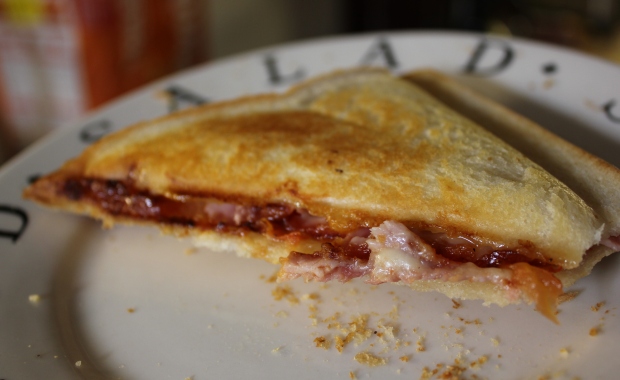
This weekend, feeling not altogether un-hungover, I bought myself a packet of ham, loaf of sliced white bread and some Gruyère and tomatoes from the Continental Deli in Brixton. And I set about making toasties. Now having not used a toasted sandwich machine for over five years, I’m not expert, but this did a pretty good job (see below) – and toasties are ideal hangover food. My only regret is that I think I could have taken more advantage of this machine’s ‘deep fill’ status and pack in a bit more cheese. But you know, we’re living in austere times!

Ham and gruyere toastie

Ham, gruyere and tomato toastie with a glug of Tobasco

Merry Christmas, one and all

It’s been something of a slow burner, but I’m finally feeling festive – to the point where my mum had to hide the After Eights from me last night. If you’re not feeling the Christmas spirit just yet, I suggest watching this video (thanks to David Drummond for that one):


And then making this lovely stuffing, as I did, yesterday. It’s to go under the skin of the turkey tomorrow and I think it’s going to be rather good – being a mixture of fennel, onion, lemon zest and a splash of vermouth to give the bird a bit of a lift. It’s based on a recipe from Ina Garten that uses it so stuff a pork loin, which I’m going to try another time, and if you’re still stuck for a stuffing recipe it’s really quick and simple. I added some lemon zest to the equation, because I think a hint of citrus works so well with fennel and is always good with poultry.

Ingredients
1 tablespoon of decent olive oil
1 tablespoon unsalted butter
2 cups chopped white onions (2 onions)
2 cups sliced fennel (1 large bulb)
Sea salt
Freshly ground black pepper
1 teaspoon of lemon zest
2 teaspoons chopped garlic (2 large cloves)
1 tablespoon minced fresh thyme leaves
1 tablespoon Pernod, Vermouth or white wine
3 cups fresh bread crumbs

Method

First chop up your ingredients:

Then heat the oil and butter in a saucepan until the butter has melted, adding the chopped onion, fennel, salt and pepper. Cook over a low/medium heat for 10-15 minutes until the onion and fennel are soft and golden.

Cook the onion and fennel over a medium-low heat until soft and golden

Garlic and thyme

Add the garlic and thyme and cook for another minute, before adding a good slug (about a tablespoon of Pernod or, in my case ‘Noilly Prat’) and deglazing the pan. Then take the whole thing off the heat and allow to cool.

Then you just add the breadcrumbs – three cups full – mix it all together with another pinch of salt, and you’re away!

La Boca, Buenos Aires

In November I was taken on a press trip by Wines of Argentina. Lucky, lucky me. Over the course of six days I would explore a country I’d been lusting over for years, meet some lovely fellow journalists and wine folk, and drink more Malbec than a City boy with a drink problem. The overriding impression after days of visits to wineries in Mendoza (where 70% of the country’s wine production occurs), Salta and Cafayate was one of a wine industry populated by incredibly passionate winemakers, producing wines of excellent quality, value and unique character, thanks to the country’s widely ranging climates and terroirs. And while almost all of the producers we met were keen to show us their Malbecs – this is, after all, the Argentinian wine – we discovered that there is so much more to the region, tasting some excellent Pinot Noirs, fragrant Torrontes and Viogniers.

Wine tasting and family snaps at Hacienda Del Plata, Mendoza

We saw small-scale, family-owned operations like Hacienda Del Plata (above), which produces just 55,000 bottles a year and is run by the Gonzalez family, who siphoned some of their spicy 100% Malbec straight out of the American oak barrel for us.

The organic, biodynamic 100 year old Krontiras vineyard in Mendoza

And we dipped into the biodynamic winemaking movement at the beautifully wild Krontiras vineyard, where whole hedgerows of overgrown rose bushes flank the 110 year-old vines. Here we drank chilled, surprising fresh Malbec from this year’s harvest.

But we also visited wine making giants like Clos de los Siete, a collection of five state-of-the-art wineries (one of which belongs to Benjamin de Rothschild) overseen by lauded wine consultant Michel Rolland, where visitors can hire horses to wander through the vines and eat gourmet fare in its restaurants.

Horse back vine observations at Clos De Los Siete in the Uco Valley

At the Dutch-owned Salentein, also in the Uco Valley, we were amazed by the imposing architecture of the winery – with its vast glass and concrete structure that looks, from the outside, like some kind of sinister Bond villain’s lair. Inside, a cavernous sunken wine room is filled with oak barrels, with a grand piano in the centre of the room – an indication of this producer’s dedication to the arts. Salentein has its own gallery showcasing some of Argentina’s finest artists alongside a small Dutch collection.

The amazing barrel room at Salentein. But where are the sacrificial goats?

I will be writing about the wine makers we visited in more detail next year for Waitrose Kitchen magazine – so keep an eye out for that.

And what of the food!? We sampled everything from chic, high-end restaurant cuisine – which in Buenos Aires and Mendoza competed with anything you might find in New York or London. Ingredients were often hyper-local and restaurant repertoires usually drew heavily from Mediterranean techniques and flavours, while the more rustic, traditional meals we had were astounding in their simplicity. We tried empanadas of all shapes, sizes and fillings, because recipes for the speciality – which has its origins in Moorish cuisine – are fiercely regional. In the Uco Valley we learned how to make them according to the Mendozian method, and I’ll be putting up a recipe soon – but my particular favourite was one filled with a gooey, peppery morcilla (Argentinian blood sausage) that we ate during a tasting with Argento Wines.

Making empanadas in the Uco Valley

Obviously there was a large amount of insanely tasty cow involved on the trip – though I got the feeling many of our hosts assumed we’d been bombarded with steak and gave us alternatives, so plenty of pork, deer and veal were consumed too.

Veal tenderloin wrapped in ham with smashed potato and truffle sauce at Restaurant Familla Zuccardi, Mendoza

Not to mention asado – the traditional Argentinian barbecue whereby different cuts of meat and sausages are slowly roasted over glowing charcoal – never a direct flame – giving them the most delicious and intense flavour. If you’re lucky, desserts will involve some form of dulce de leche – the insanely moreish sweet delicacy of sticky milk caramel.

Coffee is also done incredibly well here, and in Buenos Aires, which was ablaze with violet jacaranda trees when we visited, we ventured to Cafe Tortoni, one of the city’s oldest, and best-loved coffee houses (there was a queue when we arrived), for a restorative caffeine fix.

Cafe Tortoni on Avenue de Mayo, Buenos Aires

I went for an iced cappucino, which was thick, cool and sweet and flavoured with orange and cinnamon:

Iced cappucino

At Casa Cruz restaurant in the plush Palermo neighbourhood of the city, we feasted on tomato tatin stuffed with a rich goats cheese, onion and herb filling, followed by white salmon wrapped in an almost-caramelised ham served on deep, smoky lentils.

White salmon and lentils at Casa Cruz

Our first really traditional meal of empanadas and asado came at the beautiful House of Jasmines hotel, a boutique Relais and Chateaux property in Salta – which – get this, used to belong to Robert “I love the smell of napalm in the morning” Duvall.

Empanadas!

Mmmmmmeat

Sausages cooking over the asado

The meat just kept coming! And that is pretty much the story of eating in Argentina. When we drove through the little remote villages on the beautiful drive from from Salta to Cafayate, we were amazed by how many butchers each one had – every other building seemed to be advertising meat or chicken (or, more incongruously, Coca Cola) – because this is what their diet consists of. And they waste nothing. Offal, charcuterie and blood sausage ensure there’s no such thing as meat monotony. You’ll find it hard if you don’t eat animals, but if you do, expect to taste some of the best meat you’ve ever had. And surely there are few things better than eating wonderfully free range meat, washed down with interesting, well-made wines against a backdrop of astounding natural beauty?

The journey from Salta to Cafayate is a glorious drive past rust red sandstone hills and canyons

Grant Achatz at his restaurant Alinea in Chicago

In foodie circles, Grant Achatz – whose cutting edge, three-Michelin-starred restaurant Alinea has twice been named the best restaurant in America by Restaurant Magazine – needs no introduction. But outside of that, he’s still the best chef you’ve probably never heard of. While in Chicago, I was lucky enough to spend a couple of hours with him, listening intently as he talked me through his career to date. “What do you want?” he teased in gravelly Midwest tones, before talking candidly about his route from cooking standard diner fare in his family’s Michigan restaurants to discovering, via the CIA, French Laundry and a four day stint at El Bulli, that “I could actually express myself through food, make people feel a certain way and evoke emotion. Who knew?”

Anyone who’s ever eaten Achatz’s food, is the answer. While we were talking, he sent me out a couple of dishes. One was his famous ‘hot potato, cold’ potato’ – a cool, intense truffle and potato soup served in a wax shell pierced by a needle threading a piece of hot potato, cube of parmesan,  butter, chive and black truffle. He told me to pull the needle through the shell (“you can’t do that with porcelain”) and the ingredients fell into the soup, which I then swilled like an oyster, resulting in the most delicious mouthful of textures, tastes and temperatures. Then I was given a sort of beignet of pheasant and apple jelly with roasted shallot, all coated in a crisp tempura batter and served at the end of a cluster of smouldering oak leaves. “When I was growing up in Michigan my father used to take me pheasant hunting, right around the time that we’d burn the oak leaves on our street – as is traditional in the Midwest. I wanted to make a dish that evoked my childhood in that way – this to me is fall in Michigan.”

hot potato, cold potato

Achatz lights the oak leaf to evoke "the smell of Michigan in fall"

His new restaurant Next, which opened in April this year in the trendy Fulton Market district, is not a fine dining temple in the Alinea mould. It’s a buzzy, brasserie-style  restaurant with former Alinea chef de cuisine Dave Beran at the fore. But being Achatz, of course there’s a twist – the theme of it changes every three months. It was ‘contemporary Thailand’ on my visit, and as you can see, we were treated to a rainbow of beautifully rendered Thai food… one of the best and most entertaining meals of 2011.

Roasted banana, fried garlic, pickled shallot, cilantro blooms

A grill was brought to our table with skewered tamarind chicken hearts, squid and strawbs

The 'Next' Pad Thai with sous vide egg cubes

Hot and sour broth, pork belly, tomato, kaffir lime

an assortment of Thai pickles

Wild catfish braised in caramel sauce, celery, coriander root

Braised beef cheek, curry of peanut, nutmeg, coconut, lemongrass

Coconut, corn, egg and licorice

See above

Dave Bevan, head chef of Next

Harissa with creme fraiche and burnt lemon

Believe the buzz. Ducksoup – and I’m not talking about the 1933 Marx Brothers film – is the shizzle. Or at least, it was when I lunched there last week - packed tightly into my rickety wooden chair on the tiny, jewel box ground floor of Soho’s latest small plates restaurant. As I dashed inside, out of the freakish heat, I noticed that the faded ‘Zilli’ logo was still visible on the restaurant’s sun curtain (I know there’s another word for that – help me out please, someone?), but this is a far cry from the vegetarian celeb cheffery of its predecessor. On the bar  - which takes up the majority of the small room – was a handsome looking ham, and some Tête de Moine, and behind it stood the unshaven Julian Biggs (below) – the former executive chef from Hix restaurants, who has struck out on his own with ex Hix Oyster & Chop restaurant manager Rory McCoy to open this place.

Wines, many of them natural (I spotted the divine Alsation biodynamic grower Binner’s Les Saveurs Alsace 2009) are written up on the blackboard, and there’s a very pretty copper stand temptingly filled with chilling fizz. We were in a hurry, and this was a working lunch, so we just went for tap water – which was gracefully brought in a little ceramic jug.

hand-written menu

The biro-scrawled menus are adorable, but cutest of all is the restaurant’s ‘bring your own vinyl‘ policy, whereby you can put your own records on the little player that sits on a shelf near the corner. We lunched to the nostalgic harmonies of Simon and Garfunkel, and I couldn’t help fantasising about what might happen if I disrupted the cool vibe by busting out my Wings (“only the band the Beatles could’ve been”)  EP…

Ducksoup is one of those places that is good value, but not cheap. Small plates are £7 and bigger, main-sized portions are double that at £14, which makes sense. You’re paying for quality produce here, and, thanks to the accomplished cooking, you can really taste it. It’s very much in the St John/Terroirs school of not putting more than three or four ingredients on each plate – with vibrant flavour combinations and everything impeccably fresh. Despite being a former Hix boy, Biggs is very much looking to the Med here – there’s a lot of olive oil, herbs and regional cheeses. We shared the toast with lardo, girolles and parmesan – which was fresh, juicy and moreish:

lardo toast with girolles and parmesan

Then came the plump, tender lamb cutlets, grilled until the fat had caramelised and crisped – but still moist and juicy and simply dressed with fresh torn marjoram and a delicious slick of fruity olive oil.

Lamb cutlets with marjoram

Our third and final dish was the star dish, and had me chewing on the bones, trying desperately to get the most minute scrap from the carcass – it was that good. One perfect golden little quail, nicely seasoned and served with brilliant simplicity, accompanied by just half a burnt lemon and a bowl of crème fraiche which was marbled with saffron-coloured harissa. Harissa goes so bloody well with quail! And the crème fraiche gave a piquant, indulgent edge to the dish. I just wish we’d ordered the big one.

Quail, crème fraiche, harissa and burnt lemon

Our bill came to to £28 for two, which isn’t bad – but we didn’t have wine or dessert. Go to Ducksoup I’d say, go and eat all you can while you can still get a table.

41 Dean Street, Soho, London, W1D 4PY

Today I have an article published in the Independent about Sven Elverfeld, a three-Michelin starred chef in Germany whose inventive renderings of his national cuisine has put the unremarkable industrial town of Wolfsburg on the global food map.

You can read the piece here, and below are some photos from my visit. Enjoy!


Sven in his kitchen

Sven and his lab-to-kitchen kit

This is a machine that the chef got from a science lab. “It makes a 26000 rotations in a minute and with it I can make a toffee.” Said toffee is a sticky mixture of olive oil and balsamic vinegar.

The kitchen at Aqua

The pastry chef making yoghurt balls with liquid nitrogen

The yoghurt ball

A big bowl of woodruff

A lovely dish of cod with morels and fresh peas

Simmered corned beef from Müritz lamb with Frankfurt-style green sauce, potato and egg

That wonderful woodruff and rhubarb dessert

On returning to Copenhagen for a second time this year, the first thing we did was go and eat at British chef Paul Cunningham’s Michelin-starred restaurant The Paul, which is set inside the 1800s children’s amusement park Tivoli. Walking into The Paul is a bit like what I imagine it might be like walking into Cunningham’s subconscious. The octagonal, summer-house-esque interior is flooded with natural light, and drips with the chef’s own photography, artwork he has commissioned, and little trinkets, curiosities and oddities he’s collected along the way. I had been a few months ago (though not to eat as the restaurant was closed for a refurb) to interview Paul for Chef Magazine, and I had heard from his peers Claude Bosi and Sat Bains that this chef’s cooking was bold, original and innovative – much like the man himself. It was nice to be back. It was also rather fortuitous, given that, as the chef’s charming maître d’ brought us over delicious little snacks to eat with our champagne, Paul dropped the bombshell that he is closing.

The 42-year-old chef explained that he’s come as far as he can at Tivoli. “If I don’t make a break now, I’ll be pensioned at Tivoli. I want to do something much more creative. I’m not closing down – I’m closing down The Paul. There’s nothing definite yet but between now and the 24th of September [The Paul's last supper] something will be set. I can’t wait. The Paul will be put into the archives and ‘P2′ is the working title of the new project.”

Cunningham, who insists he’ll take his staff with him wherever he goes next, is not short of offers – and is considering projects in Denmark, London and Provence. “I’ve reinvented myself many times over the last ten years and I can’t do any more in Tivoli,” he said. “I feel happier and more content than I have in a long time and I’m very excited about the future.”

So it was with both excitement and a sense of  privilege that we sat down inside The Paul to enjoy what was to be our first and last meal there. And it didn’t disappoint. We had the chef’s summer menu. Here is our meal in words and pictures.

Oyster & Rossini caviar, cauliflower

This was a lovely light start. The oysters were plump, juicy iodine hits softened by the creamy cauliflower puree. I liked the textural intrigue here – the fresh, crunchy caulie against the pearly caviar and froth. A delectable start.

new potatoes, mussels, lemon verbena & smoke

new potatoes, mussels, scallops, lemon verbena & smoke

In the nicest possible sense, this dish reminded me of the flavour of Frankfurters. Something to do with the meaty mussels and the smoked scallops together. It was umami central and the bouillon was intense and moreish, the potato lending an earthy, comforting edge and the verbena powder a fragrant note.

Raviolo – beans, ibérico, mint and tomato water

I can still taste this. The salty, deep ham forming a lovely melting envelope around the most vital peeled broad beans. The clear tomato consomme was so refreshing – like inhaling inside my dad’s old green house – and the mint was a stroke of genius, lifting the dish wonderfully. The flavours here are simple and it really works: summer in a bowl.

Black garlic, grilled summer onion, charred monkfish

This dish was mega. I love the way it has so few ingredients but has the utmost impact. Black garlic (amazingly umami-rich fermented garlic) is an ingredient that is starting to get some real gourmet attention. I first heard about it from Sven Elverfeld who uses it at Aqua, and there have been some threads about it on Chowhound too. It’s so delicious: deep, sticky and mellow in its garlic-ness. Here Paul had cooked loads of it with butter (see below) and made it into a smooth paste that worked beautifully with the plump, moist monkfish and simply grilled onion.

Black garlic butter

Garden herbs, yoghurt, Himmerland sweetbreads & salted lemon

I’m not the world’s biggest sweetbread fan (there – I said it), but these were fab. Moist and juicy and coated in a light, crunchy batter, with some great acidity from the yoghurt, and a lovely fresh green edge from the herbs. I was starting to get a bit full by this point though…

guinea fowl Jean-Claude, coffee, chanterelles & capers

This is one of those dishes that when the chef was describing it to me I was seriously wondering if it was going to work – especially when he used the words ‘praline’ and ‘coffee’. But it absolutely did. The guinea fowl – which is a favourite of mine – was cooked to perfection; one piece coated in a sweet, crunchy praline, the other slowly cooked in a deep but subtle coffee jus, which really brought out the flavour of its intense poultry fat. The mushrooms complimented the whole thing with their succulent, juicy texture and the fried capers (only ever had them done like this at Viajante) gave a sharp, crunchy edge.

We didn’t have room for desserts, but this was one  of the most accomplished and vibrant meals of my year and I do encourage anyone who is planning a trip to CPH before the summer is out to get booked in. But for  those of you who can’t, watch this space for more news on Cunningham, because something tells me that whatever he does next is going to be even more wonderful…

Matching glasses

Last week was rather epic in eating out terms. It all kicked off on Wednesday with a meal at the City outpost of Le Relais de Venise with some friends I was recently in France with. We needed an excuse to consume lots of calories while drinking cold rosé and feeling vaguely like we were still across the channel. And boy did it work -  I know the place has had some flack for its ‘special sauce’ and faddy concept (and OK, it is a little bit like a French-themed Betty’s tearoom), but from the minute I walked in I felt like I was in France. I love that they write on the paper table cloths. I love the no-choice menu, and I love the fact you get two helpings of steak and sauce, with as many of those gorgeous little frites as its humanly possible to consume. After our third bottle of wine we were even smoking the things. HILARIOUS. We moved on to the Anthologist for a nightcap Aperol spritz. It’s the cocktail of the summer I tell you!

Meal of dreams at Le Relais de Venise

Thursday night was more local – a friend’s birthday in Camberwell, at none other than the highly-regarded Angels and Gypsies. Aside from being a sure sign of the area’s growing gentrification, the restaurant is bloody beautiful inside. Bare brick walls, stained glass windows and a big, imposing round bar bearing handsome ham legs and special wines on the blackboard. My mouth was watering before I even sat down. A flippant peek at the wine list resulted in an incredibly high pitched squeal as I realised that one of the most affordable wines on the list was none other than the wine I had tasted and brought back from my aforementioned trip to France.  It was a Chateau Unang Côtes du Ventoux 2009, a blend of Clairette and Roussanne made on a small scale by a very passionate, Scottish biodynamic wine maker, and the very wine we’d travelled in my friend @sophiedening’s 30-year old Nissan truck (called ‘Le Mary’) to degust.  Here we were, in the depths of Camberwell and there it was, one of the first things on the wine list, and very fairly priced at £18. We drank it throughout our meal, with dishes of deliciously creamy prawn croquettes, broad beans, peas and crispy, salty ham, steak with quails’ eggs and wonderfully garlicy sauteed potatoes.

Angels and Gypsies in Camberwell

Friday saw me fulfil a bit of a dream of watching some live Nadal action at Wimbledon, thanks to the very ample hospitality of Compass’ Restaurant Associates. As someone who worked for three years as a ‘night steward’ at the Championships (basically standing around from 8pm-8am with a walkie talkie, looking after the somewhat eccentric folk that sleep overnight for ground passes), it was rather nostalgic to be back, walking past the stewards in their high vis jackets, remembering the care-free days of uni. But this was to be an altogether more civilised affair than my summer job’s midnight lunches in the empty, neon-lit Media Centre, where we traded in coupons for hot meals. We lunched in the Gatsby Club – the RA’s corporate hospitality venue in the cricket ground opposite the tennis compound, and very good it was too. It started with smoked salmon and beets (pictured), followed by the most delicious stuffed quail with morels and an intense chicken jus. It was restaurant standard, and remarkable given that the room was seating a couple of hundred at least. About twenty minutes in I got to shake the hand of none other than the legendary Albert Roux, who had consulted on the menu and was doing the rounds.

Smoked salmon at The Gatsby Club

After a few hours of tennis, during which the humourless Sharapova thrashed determined and plucky Brit Laura Robson, we retreated back to the Club for an afternoon tea of finger sandwiches, scones and clotted cream – during which a debate ensued as to whether to spread the cream or jam first. We concluded that jam should go on first, based on someone’s comment that the cream should stand proud above the jam. I’ll second that. An hour of Nadal and Muller followed, which was cut short for a very good reason: I had an evening reservation at Roganic, Simon Rogan’s new Marylebone restaurant.

Roganic

Roganic stands next to Trishna on Blandford Street and Rogan (the Michelin-starred chef patron of Cumbria’s dazzling L’Enclume) only has the lease for two years. There is some talk that this could change, and I sincerely hope it will. In Cumbria, the chef’s food is centred on local produce – much of which is grown on his organic Howbarrow Farm, and sourced from small suppliers in the region. Here, the young chef @benspalding who’s at the helm, has a bigger net for produce, but the food is still reflecting Rogan’s light, inventive style and knack for flavour combinations. It’s a tiny, doll’s house-esque space decorated very simply, but in a very chic way (that’s down to Penny Tapsell, the chef’s partner), and the service is informed, relaxed and knowledgeable - just as it should be. This being Rogan, there is an element of surprise and fun – the dinner menu is ten-course and no-choice, and there are sweet little flourishes – like the fact that the creamy butter, which is jewelled with salt crystals is slathered on a ‘hand-picked’ Folkstone beach rock, and water tumblers are made out of recycled beer bottles by “convicts in Cardiff”.

Said rock and glasses

A dish of salt-baked turnip with smoked yolk and sea vegetables was fantastic – the smokiness of the yolk adding a rich depth to the other ingredients:

Scarlet ball turnip baked in salt, smoked yolk

But my absolute favourite had to be the Kentish mackerel, cured in seawater and served with an elderflower honey. Mackerel and honey? Who’d have thought that would be a nice combo? Simon Rogan of course! It’s a masterful dish, the fish lightly cured and falling-apart fresh, its savoury flavour lifted by the delicate, floral honey and the whole thing given a lively crunch by some very thinly-sliced onion and baby broccoli.

Seawater cured Kentish mackerel, onions and honey

Another stand-out dish was the roasted brill with chicken salt – which are amazingly delicious little nodules of crispy chicken skin – which came with cockles and ruby chard. The brill was fresh and meaty and gave a great texture contrast to the crispy little chicken skin balls.

Roasted brill, chicken salt, cockles and ruby chard

It’s great to see a chef like Rogan, who has, in more recent years, defined himself through his very regional cuisine and cooking from the terroir, coming to London and giving us city dwellers a taste of his restaurant. Let’s hope his presence on London’s restaurant scene is here to stay.

Da Polpo

He’s only gone and done it again. Russell Norman, that is. The opening of Da Polpo, on Covent Garden’s Maiden Lane – a street largely occupied by uninspiring chain establishments, comes just a month or two since Spuntino made Soho’s porn district a place to eat and drink.

Of all his openings, Norman admits that Da Polpo is “the more accessible” – and this is reflected in both its location, its size (70 covers, split over two floors), and the fact it takes bookings. But while bigger, brighter and more airy than any of its siblings, Da Polpo is not exactly lacking in textbook Norman charm. There’s still an eat-around bar, bespoke light-fittings (some of which Norman tells me he hasn’t bothered filling in after installing in the wall), paper menus bursting with tempting plates and killer cocktails.

I kicked off proceedings with an Aperol spritz – a wonderful combination of Aperol (an Italian sort of Campari-style spirit), white wine and seltz, something which immediately took me back to a debauched weekend in Berlin, where I’d supped on the sprightly drinks at Club De Visionaere in Krauzberg. It is excellent news that Norman’s brought this Venetian classic to Londres.

And the same can be said for meatballs. These are going to be one of the main draws here – and there’s a whole section of the menu dedicated to them: classic beef and pork; lamb and mint; spaghettini and meatballs… We went for the spicy pork and fennel (£5) which came swimming in a bowl of beautiful tomato passata, and were so soft, savoury and delicious I could have eaten twice as many. Methinks Norman will be keeping that recipe close to his chest.

Spicy pork and fennel meatballs

But really, it is all about the Piadina meatball smash (£8): mashed up meatballs of your choice stuffed between toasted pitta with oodles of stringy mozzarella.  We went for lamb and mint. And boy it was good. Rich, meaty goodness, but fresh, zingy and moist at the same time. This will be to Da Polpo what the Brick Lane slider is to Spuntino.

The Piadina meatball smash

But those with less meat-centric tastes are also well cared for. An impossibly fresh, ripe and delectable salad of heritage tomatoes (£5) went beautifully with the classic pizzette Bianca  (£4.50), and a cicheti of grilled fennel and white anchovy was a flavour-packed little morsel:

Grilled fennel and white anchovy cicheti

But the stand-out for me was a dish of whole mozzarella with broad beans (£7.50). It was basically spring on a plate – the creamy, soft cheese the perfect mate for sweet, smooth broad beans and fresh, crunchy bean shoots – the whole thing drizzled with thick, grassy olive oil.

Whole mozzarella and broad beans

A pudding of affogati al caffe (£2.50) – a little ball of vanilla ice cream with an espresso shot poured over it is all I can manage in way of dessert, and it’s a fabulously invigorating way to round off our meal.

And so Da Polpo marks the successful spread of Russell Norman’s restaurant empire outside of Soho – where it all began. His foray into theatreland gives a dining solution for anyone who might find themselves in the Covent Garden restaurant desert (Terroirs and Les Deux Salons excepting), but it’s also worth a trip in its own right. And something tells me its not the last opening we’ll be seeing from the man who’s come to rejuvenate cool, affordable, fun dining in London.

Da Polpo
6 Maiden Lane
London Wc2 E7Na

René Redzepi and Claude Bosi in the kitchen at Hibiscus

And again.

As if you didn’t already know, René Redzepi’s Noma was voted number one at this year’s S.Pellegrino World’s 50 Best Restaurants awards. I was lucky enough to catch up with the triumphant Danish chef for Chef Magazine while he was over for the awards…

What’s the past year been like for you, since topping the ‘50 Best’ list?
It’s been a very hectic year for me. Suddenly we filled up in the restaurant. It’s full for lunch and dinner now, every day, which it wasn’t before. And at the same time, we were putting out a book [Noma: Time and Place in Nordic Cuisine] – which was a coincidence, we’d had it in the making for two years: so that was an extra push. In all honesty it’s been a very exciting year and I’m truly thrilled. I’m happy I get to enjoy this. And I know that what’s happening now will not last forever, so you have to remember to cherish the moment, and despite all the madness,
enjoy it a bit.

Noma’s success has spawned much copycatting in restaurants around the
world. How do feel about people trying to recreate what you’re doing?
I think that Coco Chanel had the best quote ever for this. “Of course I hate it, but I would hate it even more if they didn’t.” [laughs]. I don’t hate it – I honestly don’t – we are in a world where we inspire each other constantly. I’m inspired by chefs as well – it’s natural. What we’re doing is exploring our region, so to speak. We’re exploring the world through our products and our gastronomy and what has inspired people is that we’re doing it in Scandinavia – so we show that you don’t need Mediterranean type-weather, or a rich, 300-year-old cooking culture to break free, it’s just a matter
of determination and exploration. We talk about it once in a while in the kitchen, when people say we’ve been copied. We’re just a restaurant and our world is the 100 square meters of our kitchen, so it’s not something you feel or even know is going on most of the time.

How do you feel about being credited with re-establishing Nordic food culture?
I think it’s a bit bold to say that we’ve re-established our entire eating culture. We don’t have the absolute truth for how cooking should be in our region, we’re just trying. We’ve planted seeds, and let’s see what comes through. It’s looking positive, people are inspired, there’s a movement amongst chefs, purveyors and farmers – it’s all
working towards this exploration of ourselves and the idea that gastronomy is integral. It’s not the person next to you, it’s something that should come from within us, and so people are trying to figure that out. Which is not easy – it’s going to take many, many years.

When did you start discovering what you wanted to do with indigenous ingredients?
I went on a big trip to Greenland and that was truly one of the moments where a lot of things started to add up. It was amazing and I wish these things could happen more to me. There was a big snowstorm and we got stuck at this old American military base for four days. The electricity was American so I couldn’t even charge my computer or anything. The first day I was so bored, but then I started thinking about things, which turned out to be very fruitful. That was an important moment when I asked myself, ‘why am I doing this? Why do I want to work 90 hours a week? Is it for the passion for food, and if it is, what sort of food am I cooking? What do I like about food? What do I want this food to be?’ That was the first moment when I realised that as a restaurant our biggest task is to show our diners where they are in the world and what time of year they’re in. They should experience a moment in nature, that can only happen right there and then. And from that, it really started developing – just from that simple sentence.

What kinds of restaurants do you like to eat in?
I love fine dining. I love eating a personalised cuisine where the chef is trying to define himself through cooking. But I also love the opposite – healthy or tasty, or just a steak. Anything well-made I’ll enjoy. Anywhere that there’s a person who is doing it because that’s what they want to do.

Which chefs have most influenced you?
Oh there have been many. The main one was Philip Houdet, in Denmark at a restaurant called Pierre Andre. He was truly the first chef to inspire me and to push me forward and tell me that I was good at what I was doing, and say that I should pursue it. It’s very important at an early stage to have people that support you and encourage you. If I should mention one mentor, it’s him. Then there are all the people throughout time – like Ferran [Adria] and Heston [Blumethal]. For many years Sat Bains was an inspiration for me. I worked with him in France and he was older than me, and more established in his way of cooking. I remember that I really kept an eye on what he was  doing.

What’s next for Noma?
We’re still developing what we’re doing and we’re nowhere near the goal line. The day that we feel we’re at the goal line, that’s the end of the restaurant. Because it’s the process that is interesting, not the end result. I mean, I think there shouldn’t be an end result in a process like this – it’s a matter of constantly developing and challenging yourself. But of course there’s a limit to how long you can keep going.

Do you worry there’s a risk of burning out then?
I don’t worry about it, because I know it’s going to happen. I accepted that a long time ago. I just worry that when it happens, I need to be aware enough to see it, so that I don’t become a cliché or a parody of myself.

How do you relax?
It’s not time to relax now, it’s time to explore and develop. A unique thing has happened to us, and we should build on that energy in many ways. I don’t mean that we’re going to make ourselves rich or anything, but we should do things that build on the gastronomical momentum, so that we all become better in eating food, and teach diners so that restaurants in the future are better off.

First published in Chef Magazine

Older Posts »

Follow

Get every new post delivered to your Inbox.